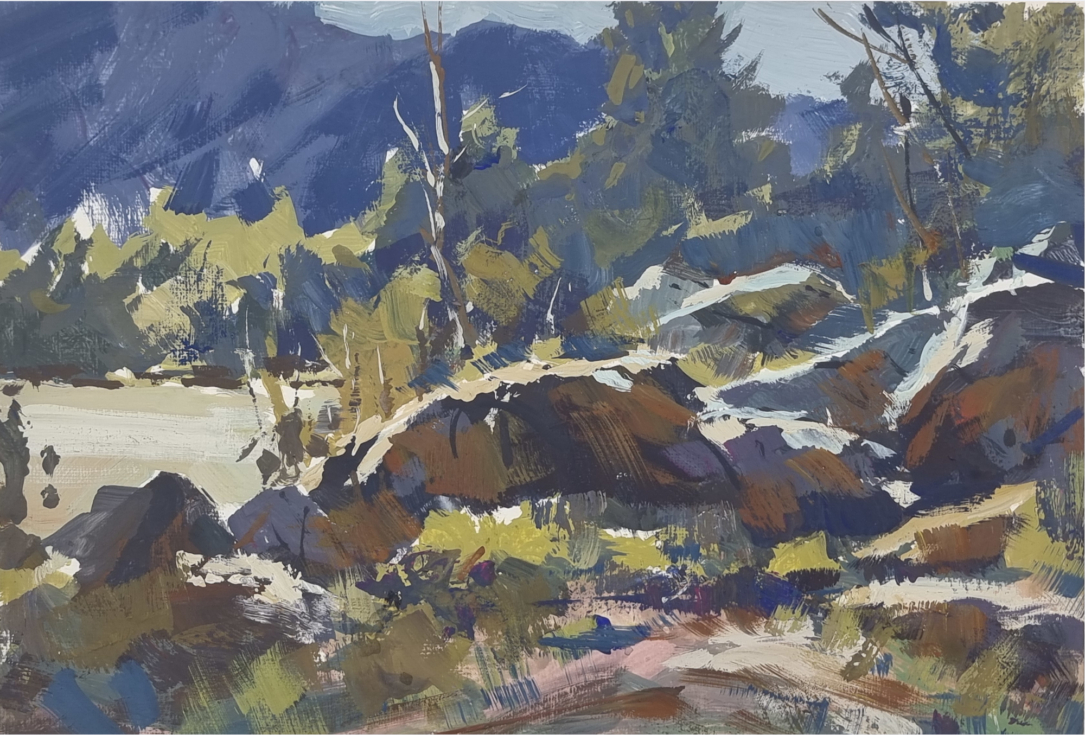













Catarina Alkemark from Sweden shares her favorite watercolor palette and techniques.
Here’s a quick Q&A with Catarina:
¿Por qué haces arte?
I think I have something in me that makes me want to create things. I have done it my whole life. If it is not painting, it can be creating a garden.
¿Cuánto tiempo llevas pintando?
My whole life. My mother use to say that my best friend and I didn’t play when we were kids, we just drew and painted all day long. As an adult, I didn’t paint for about 10 years because we were busy starting a family and renovating an old house. Since 2016 however, I’ve been more dedicated to becoming a good painter.
¿Recibiste formación artística formal?
Unfortunately, no. When I finished high school in 1989, I attended an evening art course for beginners with my friend and we learned the basics. Otherwise I’m mostly self-taught. My friends and I used to meet every week to paint. I learned a lot about drawing, mixing colors and how the paint and paper worked together. I’m lucky to live in the same neighborhood as Julie Ann Karlsson y Anders Andersson, who’ve introduced me to many other artists and whose weekend courses I’ve attended.
¿Eres un artista profesional o un aficionado?
I’m a hobbyist. I work full-time as an intensive care nurse.
Where do you look for inspiration?
I prefer to paint from places I’ve visited. The pictures need to tell a story. Instagram can be a source of beautiful photographs from around the world, if you can’t take your own photos (be sure to ask the photo owner for permission). A new color can also be a source of inspiration.
¿Qué tipo de música escuchas mientras pintas?
Lots of soul and other music I listened to when I was young, mostly from the 80’s. Calm and soft or up-tempo songs, it doesn’t matter. I didn’t know how much I needed music while painting before the pandemic. My husband worked from home during those years, and I couldn’t play music because of his team meetings. I’ve also discovered that I probably always sing when I paint. My last painting, The Barber Shop in Rangoon, was painted while listening to Aretha Franklin.
¿Tuviste un mentor?
No, but among the painters I admire is Stanislaw Zoladz, a Swedish-Polish artist who can paint water as it really looks. Someday I will try to paint water like he does. I also like Marcos Beccari for his portraits and Iain Stewart for his buildings and street views. When I started to paint nighttime city views, I discovered John Salminen and Laurie Goldstein-Warren.
¿Pintas todos los días?
Before the pandemic, I painted almost every day. But with my work as an intensive care nurse, the last three years have been really challenging for my coworkers and me. Covid hit Sweden, especially my home region, really hard. During the first months it was a relief coming home to paint, but after a while I didn’t have any energy left to be creative. The second wave hit us harder than the first one did, so it has taken some time for me to heal. I just started to paint again last fall and now I’m able to feel pure joy again.
¿Pintas una pieza a la vez o trabajas en varias al mismo tiempo?
I usually paint one at a time, working with reference photos.
Do you prefer painting in studio or plein air?
In my home studio because I paint on full sheets – the way I paint doesn’t fit with plein air.
¿Cuántos colores primarios utilizas?
It depends on what I’m painting. If I paint city nights, I use Opera Pink y Verde amarillo ftalo (perfect for neon signs). Azul Cobalto Turquesa for cool lights and Ocre de quinacridona for warm lamplights. When I’m painting buildings, the PrimaTek colors like Piemontite Genuine, Sedona Genuina, Tiger’s Eye Genuine, Turmalina Negra Genuina y Sodalita Genuina are perfect for roofs and facades of buildings.
I used to think that red was a difficult color, so I worked on learning how to paint with it. Now, reds are my favorite colors, particularly Cadmium Red Scarlet Hue y Naranja Maya. Green is my next difficult color to master, so I think you will see lots of paintings with different greens in the future. When I worked weeks with night shifts, my gift to myself was buying new DANIEL SMITH watercolors. I don’t work night shifts anymore, but I have boxes full of beautiful colors. Lucky me!
¿Tubos, sartenes o palos?
Tubes and pans.
¿Cuándo sabes que tu obra está terminada?
When I’m bored with it. Every painting takes about 40-60 hours to paint, the last hours can be really dull. I place it on my son’s old bed for 3-4 weeks and look at it every day to see if I can find something missing – maybe a shadow or highlight. While I paint, I try to take photos. That’s a good way to see what’s needs fine-tuning.
••••••••••
Únase a nosotros en línea cada semana para una conversación íntima y personal con Daniel Smith CEO y propietario, John Cogley y artistas invitados de todo el mundo. Los jueves (2:00 p.m. hora del Pacífico), John destaca varias características de nuestros productos y responde a sus preguntas. Los viernes (10:30 a.m. hora del Pacífico), un artista invitado le da seguimiento para compartir cómo incorpora esas características en su arte. Click here for the upcoming week’s Zoom links.
Check our Facebook page for news about upcoming guest artists or to watch past replays. Each Zoom meeting is also recorded and shared on our YouTube channel. La traducción al español está disponible – selecciona el canal en español en Zoom.