











This is a stage by stage process of the studio version of “Valdemossa Light” painted from a photo reference.

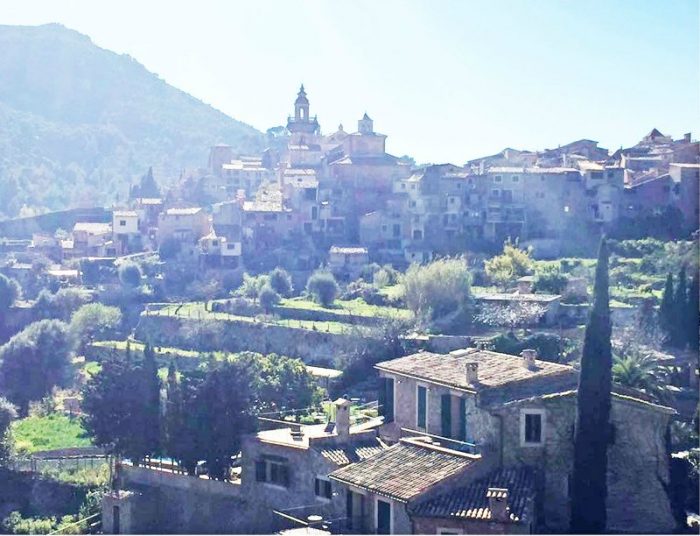
Most of the time when I paint in-studio from a reference photo, I refer to some of the sketches done on the spot or rely on my memory to remember the feel of the place.

Plein air painting of Valdemossa.

As I had already almost a finished painting on the spot itself, and the feel of the location was easy to recollect.

Reference photo of Valdemossa.

The photo reference will give you all the information needed but I think the experience which we have with all our five senses … like smell, sounds, etc. are also important. These things that we recall make a difference in the painting.

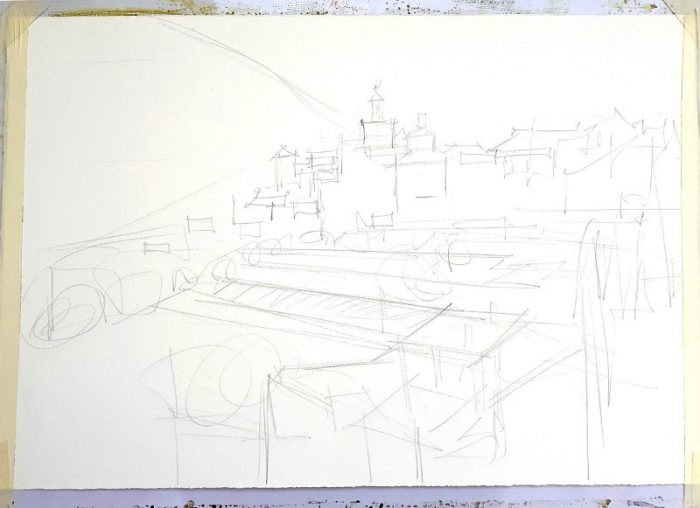
Stage 1. Pencil sketch of Valdmossa.

Stage 1 – Pencil sketch.
I blocked in the major shapes of the scene. Usually my pencil work is quite random and more of a loose approximation.

I am not that patient, so rather than spend a lot of time doing the pencil work, I prefer to focus on the general space division, a general movement, and interlocking of shapes in the painting.

Stage 2. Laying out the colors for “Valdemossa Light”.

Stage 2 – Laying out my colors for the painting.
Here I lay my colors in the palette…. though I have all the paints of my choice in my box (just received my DANIEL SMITH Watercolor Dot Card with all my picks!), I still like to use limited shades for every painting in a separate palette. [See Milind’s Dot Card color list further below].

If I need any extra accents, I keep a standard box of paint alongside for easy access.

The shades here are 鈷藍色, 酞菁藍(綠相), 酞菁綠(黃相), Permanent  Alizarin Crimson, 赭石漢莎黃光.

Stage 3. Starting with basic washes.

Stage 3 – Starting with basic washes.
The basic wash starts from the top with mix of 鈷藍色 and a touch of Phthalo Blue (GS) blending with 赭石 and bit of orange created by mixing 漢莎黃光永久茜素深紅.

Below that I add a fresh green, obtained by 漢莎黃光Phthalo Green (YS) in different  proportions.

Further down I add hints of a reddish yellow and some neutral achieved by blending 赭石鈷藍色.

Stage 4. Adding the background.

Stage 4 – Adding the background.
Here I’ve started with background cluster of distant buildings. If you notice it is one uniform variegated wash. I have used a transition of warm and cool colors, a warm mixture of 赭石, 漢莎黃光永久茜素深紅, and a cool mix mainly using 鈷藍色永久茜素深紅. 永久茜素深紅 being the common color in warm and cool but not showing anywhere in an isolated hue.

Care was taken in leaving the shining roof shapes alone.

Stage 5. Building up areas.

Stage 5 – Building up areas.
At this stage there is a slow and deliberate build up of the shadow areas of the trees and foreground buildings and a mountain behind.

While a transition of warm and cool shades, tonal variation is important here…. mostly leaving accurate negative shapes (or positive) of light areas is the most important thing here.

Most of the painting is accurately built here and all that is needed further is the details.

“Valdemossa Light”, Milind Mulick

Stage 6 – Final
Tiny additions of dark windows and accents, with some sharp line work.

Consciously keeping the economy of details and yet not making an understatement is the challenge at this stage.

The darks are created using either 赭石Phthalo Blue (GS) which is warmer or Phthalo Green (YS)永久茜素深紅 for strong cool dark.