
I am very honored to have the chance to explain here in my step by step article, my watercolor techniques, and my DANIEL SMITH color mixes for my study of the light.
I really like the reflections on glass bottles, it is a long time that I study this kind of subject. In this case I was dining at the Hard Rock Café in Budapest, during the International Watercolor Mail Art Exhibition, and while I was walking in front of the bar, the cold light hit me hard as it bounded cleanly from every reflection. I immediately thought to shoot some photographs in order to develop a watercolor in the future.
The complexity of this subject is not only about the reflection but the three-dimensionality of the various surfaces.

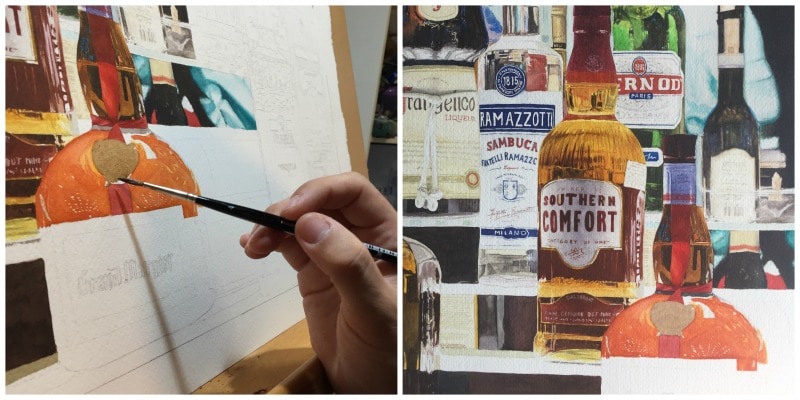
Giovanni Balzarani painting his “B’EST BAR” watercolor.
My Painting Process
The paper I have chosen for this painting is a soft press, extra white watercolor paper, 640gsm (300lb) – full sheet, 76x56cm.

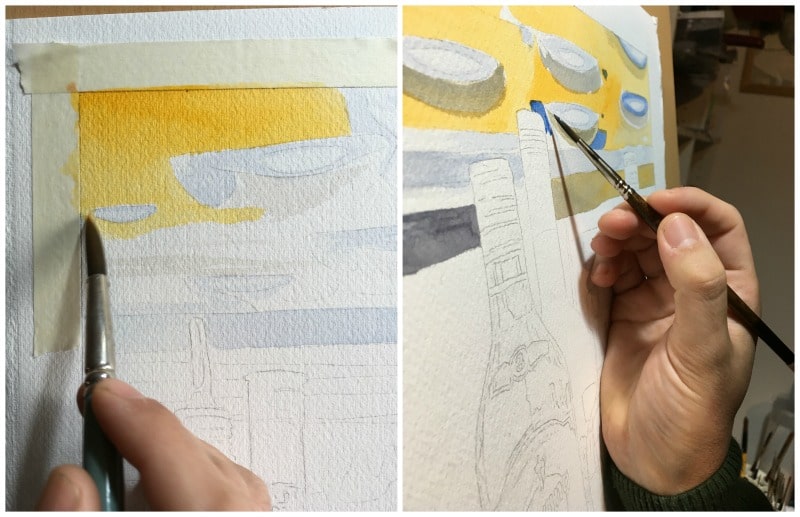
Working on the ceiling lights contour, with French Ultramarine + Wisteria + Lavender watercolors.

Adding a base of Hansa Yellow Deep + Raw Sienna Light.

Color mix of Hansa Yellow Deep + French Ultramarine + Manganese Blue Hue + Cerulean Blue watercolors. Final glaze with Van Dyck Brown.

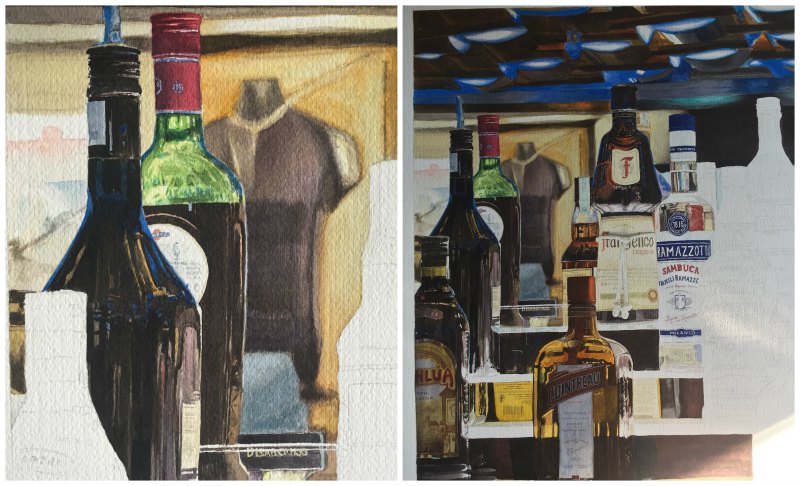
I have done the restaurant’s wall background out of focus.
Before going on with the bottles, in the various plans (layers), I have done the restaurant’s wall background, all out of focus, representing in this way the eye of the camera.

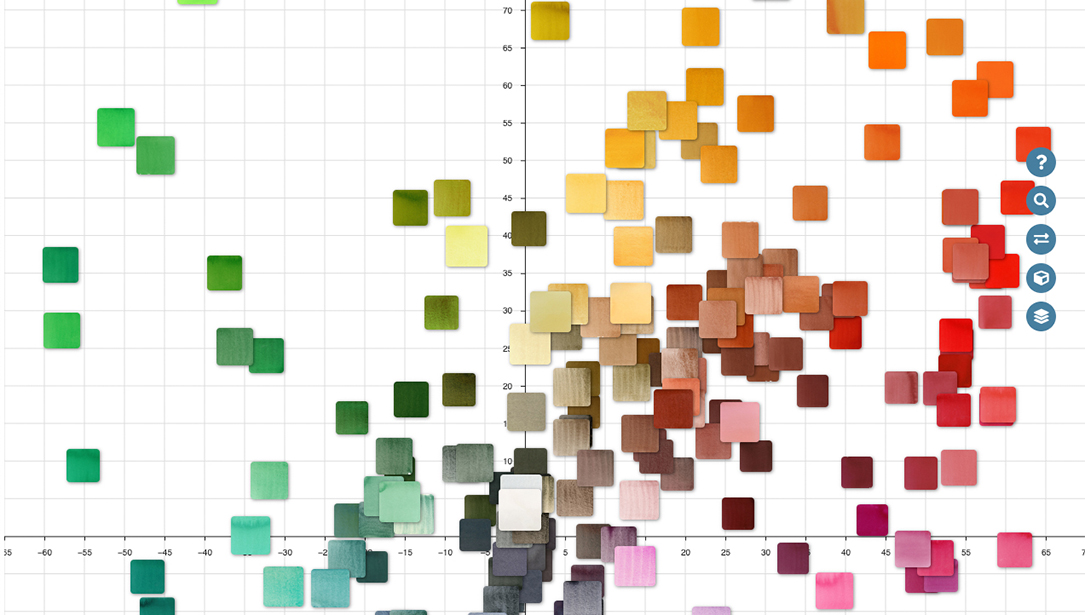
For dark tones, my most used mix is Van Dyck Brown + Neutral Tint + French Ultramarine + Mayan Blue Genuine + Mayan Dark Blue watercolors.

From left to right for all of this part of the painting.
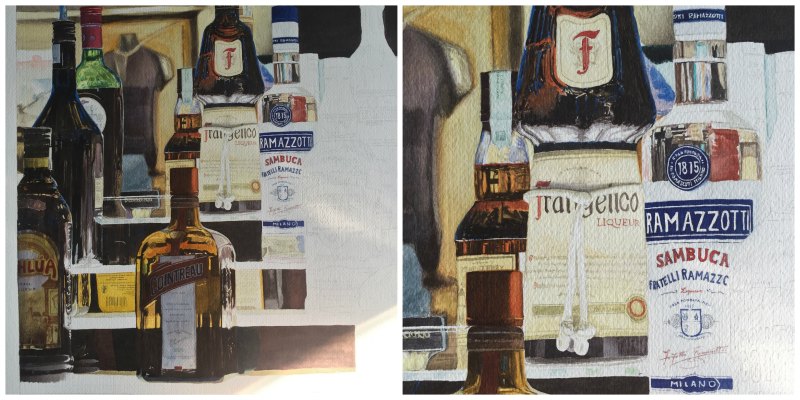
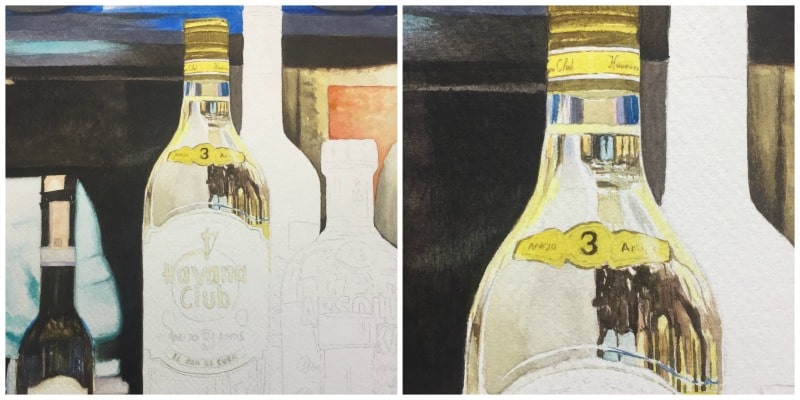
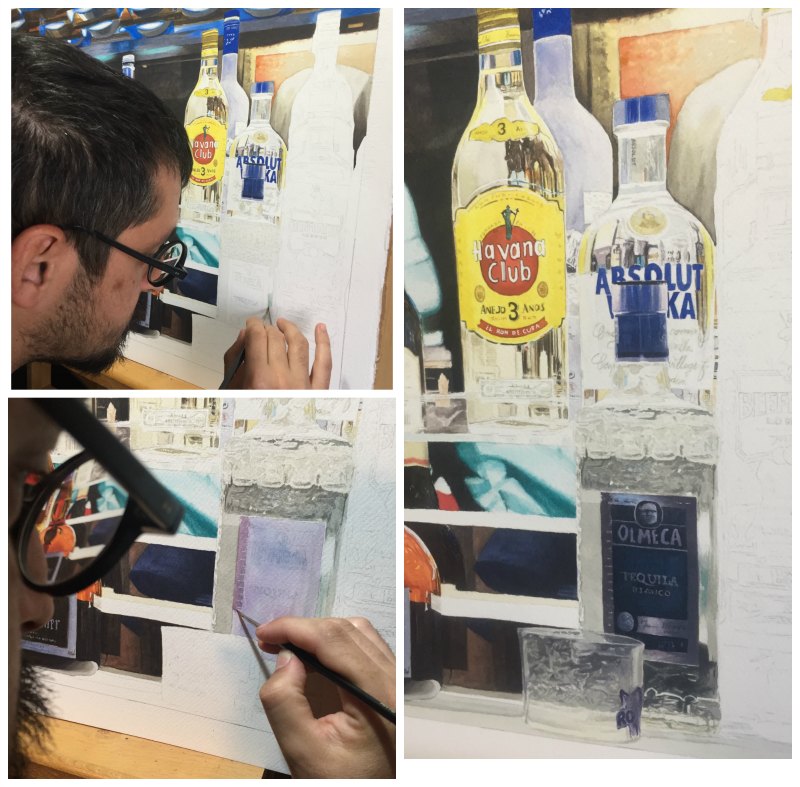
Next steps are the bottles, painted one by one, ending piece by piece, bottle by bottle. I start from left to right for all of this part of the painting. This process is the most complex because I must already paint the final light of the object without making the contour done.

For warm tones, I have made yellow glazes with Hansa Yellow Deep + Raw Sienna Light, also a mix of Quinacridone Gold + Quinacridone Sienna and Pyrrol Orange.
For warm tones, I have made yellow glazes for the base with 漢莎黃色深色 + 生赭石, and then a mix of 喹吖啶酮金 + 喹吖啶酮赭石 和 吡咯橙 for the first glaze of red tone.
喹吖啶酮金 is a wonderful base for the next glazes of reds, because of its reflective glow.
Dark color on light colors: I have always used 範戴克布朗, at a minimum percentage, and 喹吖啶酮金, as you should be able to see on the Southern Comfort and Grand Marnier bottles at their first glaze.

The prevalent mix was Naples Yellow + Titanium White + 1% Ultramarine Blue, and a little Buff Titanium.

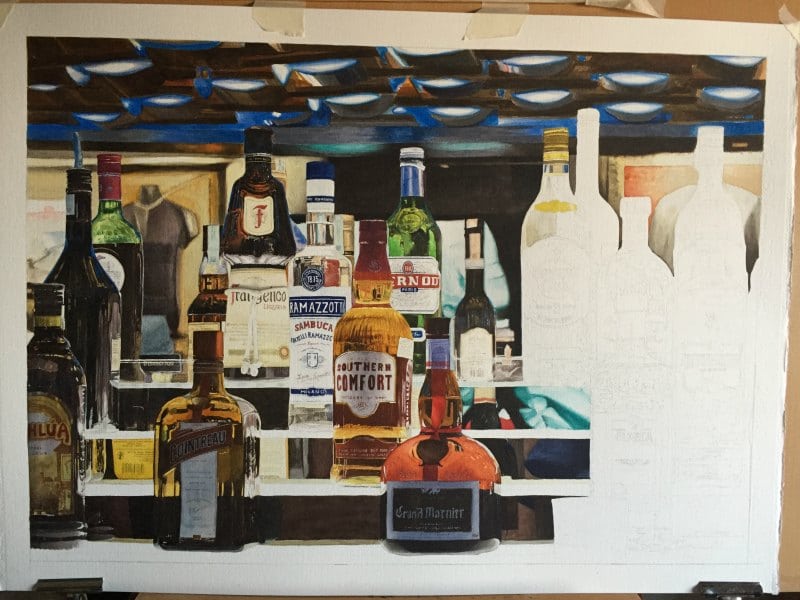
Nearly finished working on “B’EST BAR”
The most intricate (complex) work for such a composition is not about the enormous quantity of details, but about the shadows creating of all the colour tones that are there, mostly on white, because their tone percentage is almost nonexistent. Creation of such shadows creates, in turn, three-dimensionality and volume to each object.

“B’EST BAR” by Giovanni Balzarani